-
Common Commodities
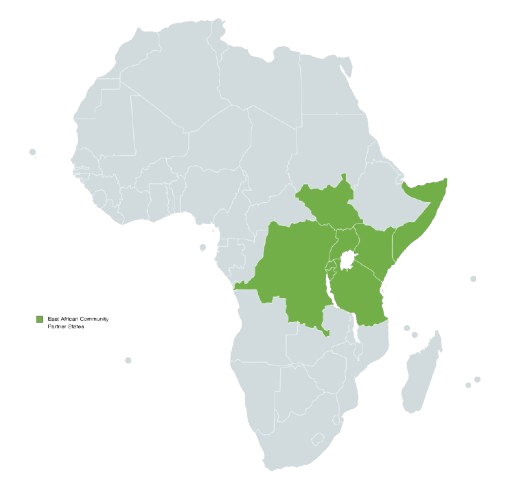
We know that food security is a pressing issue in East Africa and around the world. Especially in the Eastern African region, millions depend on staple crops such as maize, beans, rice, and sorghum for sustenance. Kenya, Tanzania, and Somalia, all in the East African region, are among the most affected countries, with food production patterns heavily influenced by climate conditions and other factors. Still, those staple crops keep sustaining their society.
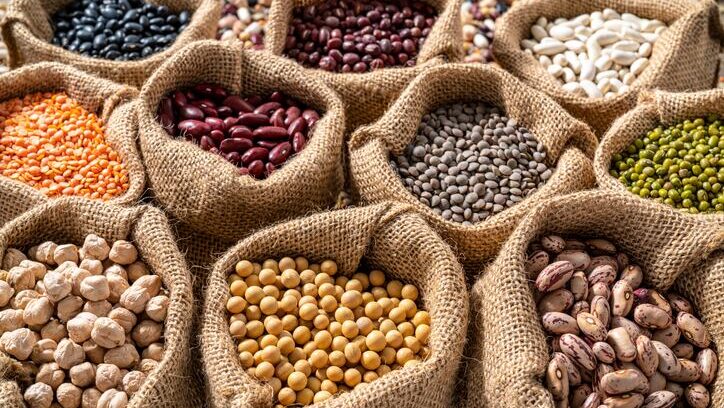
Our data reveals that maize, beans, rice, and sorghum are the top commodities in East Africa. Maize, or commonly known as corn, originated from central America and is now cultivated around the world. Beans are rich in fiber and are a popular commodity around the world. Rice is a staple food that is most common in Asia and Africa. Sorghum is a grain that is eaten as a cereal grain in East Africa.
-
In reviewing the existing research on global food insecurity, especially concerning the effects of commodity prices like rice, maize, and beans, we’ve noticed several key points and some areas that need more investigation. Research in Agriculutre shows a strong focus on how food security is linked to economic elements like food prices and climate factors (Abdallah 2021). However, they point out a lack of detailed studies on how changes in food prices directly affect nutritional outcomes, suggesting a gap in the literature that needs filling.
Globally, there is a significant impact of climate change and economic stability on food security globally (USDA 2024). Some solutions include adaptive farming methods and stable economic policies to maintain food affordability (Brown & Funk 2008). However, small island nations in the Pacific face unique challenges that aren’t as prominent in broader studies, suggesting that more localized research is necessary. Looking specifically at countries like Namibia, there is a prominent role of agricultural competitiveness in the level of food security. A missing piece in the research has been identified to be related to differences in food security between urban and rural areas, which could be crucial for understanding the full picture in Namibia.
Commodities Price Variations
Maize
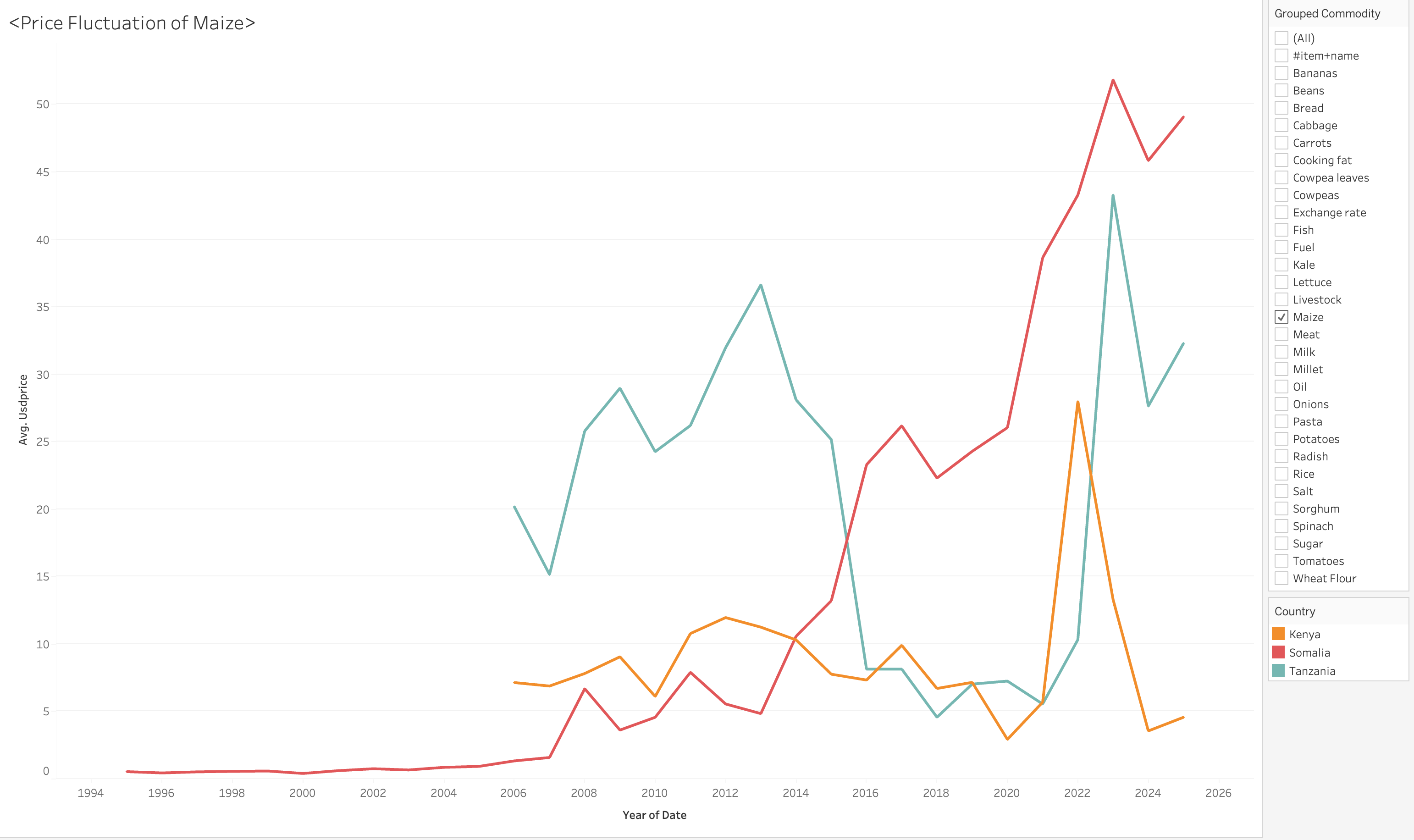
Overtime, maize prices in Somalia only showed an upward trend due to its ongoing civil war and the drought in East Africa. Tanzania had a stabilized period due to policy interventions. Kenya’s prices are mainly affected by the drought.
Beans
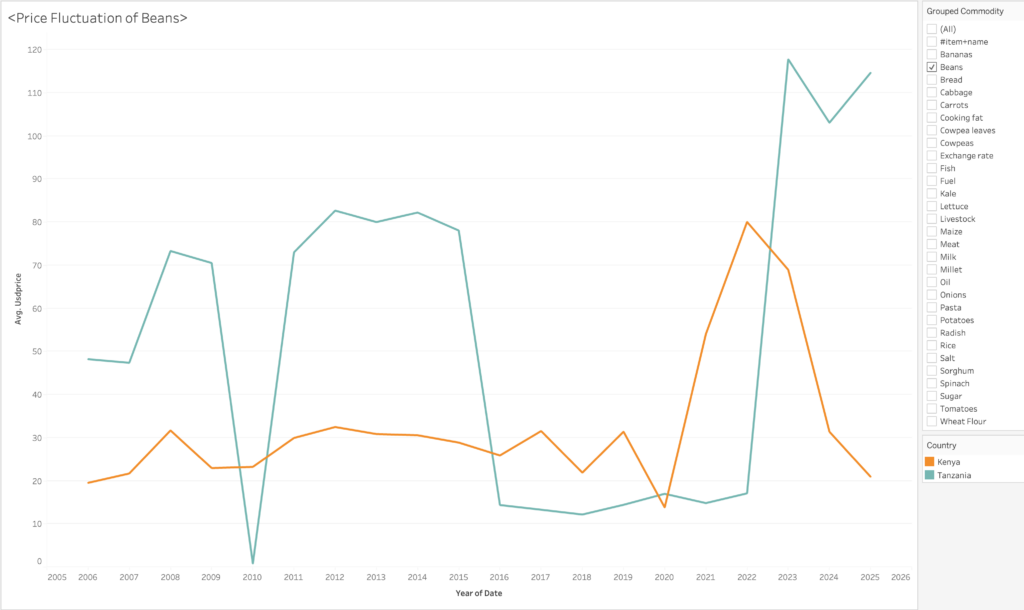
Our data set does not include information on the price of beans for Somalia.
Again, Kenya’s prices are mainly affected by the drought, showing a sharp increase around 2020. Beans prices in Tanzania fluctuate but did have periods of stabilization due to government policy changes.
Rice

The price of rice for Kenya, Somalia and Tanzania show similar trends to that of the price of maize. The only difference is the data gaps are more evident in Kenya, only recording starting from 2018.
Sorghum
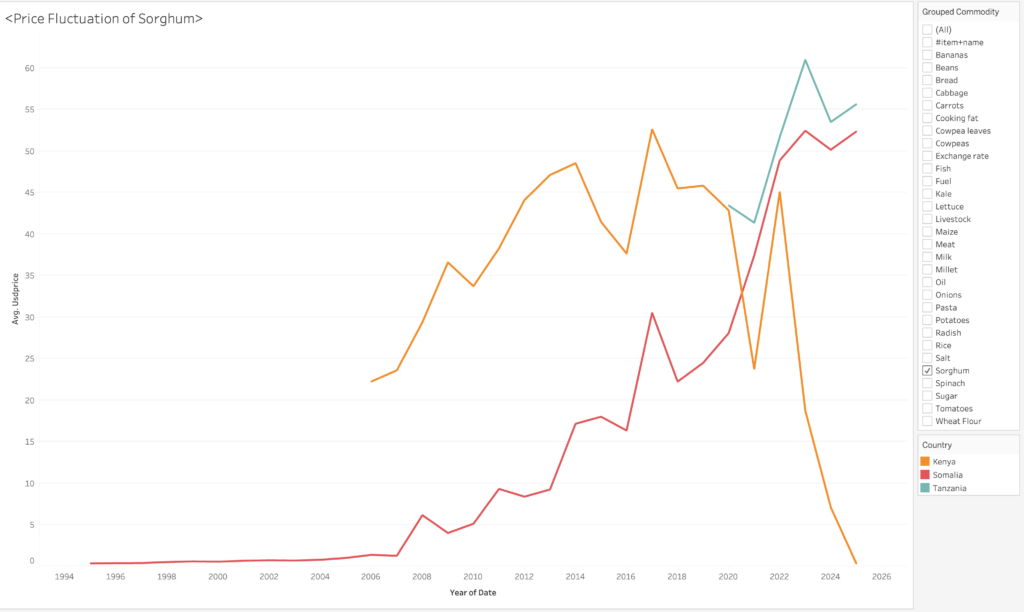
For sorghum, Kenya’s prices fluctuated over time; still, it showed a sharp drop in 2022 like the other staple food crop prices. On the other hand, prices in Somalia steadily increased over time, and our limited data for Tanzania also show a sharp increase in prices.
Analysis by Country
Somalia: In the graph, we can see that the average price of maize in Somalia began to sharply increase starting from 2008. This may be attributed to the start of civil war in the country in 2009, which has continued until now. In war, resources are scarce and prices of local goods may increase due to its limited availability. Moreover, Somalia is experiencing severe drought, which means agricultural goods are produced at a reduced level. “The 2015 – 2016 El Niño phenomenon had a severe impact on vulnerable people in Somalia – it worsened an already widespread drought in Puntland and Somaliland with a devastating impact on communities and their livelihoods, increasing food insecurity, cash shortages and resulting in out-migration and death of livestock.” A similar upward trend is reflected in the average price of rice and sorghum. Unfortunately, our dataset does not include information on the price of beans in Somalia.
Kenya: Between 2020 and early 2023, the prices of maize, beans, and rice saw a sharp increase. Our research indicates that Kenya, along with many other East African countries, was experiencing severe drought, recorded as the worst since the 1980s. This crisis left 4.35 million people facing severe food insecurity and resulted in the loss of millions of livestock due to water shortages and lack of pasture. In addition to the drought, the Covid-19 pandemic, which began in 2020, contributed to inflation in many countries. This likely exacerbated the rising cost of daily necessities, further straining household incomes and food security in the region.
To combat the issue of drought, the Intergovernmental Climate Prediction and Application Centre (ICPAC) worked with the Kenyan Meteorological Department (KMD) to develop seasonal forecasts and set up workshops for local farmers on suitable crops to cultivate based on data-driven insights. Maize, a staple food in Kenya, is widely grown despite its vulnerability to drought. Although drought-resilient and high-yielding maize varieties exist, many farmers continue to plant the regular variety, leading to repeated crop failures. To address this, experts are encouraging farmers—particularly in regions like Taita Taveta County—to consider more drought-resilient alternatives, such as groundnuts, green grams, macadamia trees, and hay farming, which are better suited to the changing climate.
Tanzania: Prices of staple crops in Tanzania have followed three distinct phases: a gradual increase, a sharp drop followed by stability with moderate fluctuations, and a sharp increase followed by a decline. The 2010s marked a crucial period as Tanzania implemented key agricultural policies and heavily invested in infrastructure, contributing to market stability and productivity growth. Favorable weather conditions during this time ensured consistent agricultural yields, further stabilizing staple crop prices. According to Tanzania’s agricultural policy profile, the country maintained a food surplus of 120-125% between 2018 and 2019, which helped sustain a steady supply of beans and prevented extreme price volatility. However, the sharp price increase starting in 2020 was likely driven by severe regional drought and disruptions caused by the COVID-19 pandemic, mirroring trends observed across East Africa.
Conclusion
In conclusion, the price trends of maize, beans, rice, and sorghum across East Africa reflect the region’s vulnerability to environmental, economic, and political disruptions. Maize prices have shown sharp increases in Somalia and Kenya due to prolonged droughts, civil unrest, and inflationary pressures. Similarly, beans and rice have experienced significant price fluctuations tied to regional droughts and pandemic-related disruptions. Sorghum prices have also risen sharply, underscoring its importance as a staple grain in East Africa. While Tanzania has demonstrated periods of price stability due to favorable policies and weather conditions, recent challenges highlight the need for sustainable agricultural practices and climate adaptation measures. Addressing these issues through policy reforms, infrastructure investments, and promoting drought-resistant crops is crucial for ensuring food security in the region.
Place in Literature
While there is a complex relationship between food prices, poverty, and food security, some research has shown that higher food prices might benefit rural areas by boosting demand for farm labor (Headey & Martin 2016). Nonetheless, the broader implications of these price increases on urban poor populations are less understood and underresearched (Timmer 2000).
During the COVID-19 pandemic, policies were implemented to stabilize food prices (Laborde 2023). They found that while short-term policies had some success, there is a lack of research on long-term strategies needed to fortify food systems against future crises. Although there’s a consensus on the significant role of economic and environmental factors in influencing food security, there are still debates and unexplored areas, especially regarding the regional effects and long-term sustainability of food systems. More detailed research and collaboration is needed to better understand how food prices impact nutrition and health directly and to develop more effective strategies for tackling global food insecurity.
We are working on global food insecurity because we want to better understand how shifts in food prices driven by climate change, political instability, and economic inequality affect affordability in different parts of the world. Although research has shown the link between food prices and economic or environmental factors, there is still a gap in understanding how these fluctuations directly impact access to nutritious food, especially in urban versus rural areas and small island nations.
By analyzing price trends from the World Food Programme’s Global Food Prices Database, our goal is to identify the regions most at risk and offer policy recommendations that can strengthen food systems. Ultimately, we hope this project adds to the larger conversation on food security and helps create more targeted solutions for ensuring fair access to food and long-term market stability.